

SOL is Solana's native cryptocurrency, used for paying transaction fees and securing the network through staking. With an inflationary model starting at 8% and decreasing to 1.5% long-term, SOL rewards validators and stakers while a burning mechanism removes a portion of fees from circulation. This guide covers everything you need to know about SOL in 2026.
If you've been exploring Solana, you've encountered SOL, the network’s native cryptocurrency. It's the fuel that keeps Solana running, the incentive that secures the network, and a productive asset that can generate yield through staking and DeFi.
This guide breaks down everything you need to know about SOL: what it's used for, how its tokenomics work, the inflation and burning mechanisms, staking rewards, and how to acquire and store it. Whether you're looking to understand SOL as an investment or want to put your tokens to work, you'll find the complete picture here.
What Is SOL?
SOL is the native cryptocurrency of the Solana blockchain. It uses the SPL token standard (Solana's equivalent of Ethereum's ERC-20) and serves as the fundamental unit of value within the ecosystem.
Every interaction on Solana requires SOL. When you swap tokens, mint an NFT, interact with a DeFi protocol, or send a payment, you pay a small amount of SOL as a transaction fee, making SOL essential for anyone using the network.
Beyond fees, SOL plays a central role in Solana's security model. Validators stake SOL to participate in consensus, and token holders can delegate their SOL to validators to earn rewards. This proof-of-stake mechanism aligns incentives: those who secure the network well (by maintaining high uptime and accurate voting) are rewarded with inflation and fee distributions. Malicious or poor-performing validators primarily face missed rewards rather than automatic stake loss (Solana does not currently implement in-protocol slashing).
Key Facts About SOL (2026)
- Current ranking: #7 cryptocurrency by market cap
- Market cap: Approximately $50 billion
- Average transaction fee: $0.00025 (fractions of a cent)
- Theoretical throughput: Up to 65,000 transactions per second
- Initial total supply: 500 million SOL
- Current inflation rate: Approximately 3.84% (decreasing by ~15% annually toward a long-term target of 1.5%)
- Staking APY: ~5-6% for native staking; 6–8%+ for liquid staking (e.g., Sanctum Infinity often tops the list)
What Is SOL Used For?
SOL has five primary use cases within the Solana ecosystem:
1. Paying Transaction Fees
TL;DR: Every action on Solana costs a tiny amount of SOL. Fees average $0.00025 per transaction, meaning you could make 4,000 transactions for $1.
Every transaction on Solana requires a fee paid in SOL. Whether you're sending tokens, executing a smart contract, minting an NFT, or trading on a DEX, you need SOL in your wallet to cover the cost.
The good news is that Solana's fees are extraordinarily low. At approximately $0.00025 per transaction, they're essentially negligible for most users. This enables use cases that would be impractical on higher-fee blockchains like micropayments, frequent trading, gaming interactions, and more.
A small portion of these transaction fees is burned (permanently removed from circulation), while the rest goes to validators.
2. Staking and Network Security
TL;DR: Stake SOL to help secure the network and earn 5–8%+ APY depending on your method. Your stake incentivizes validators to act honestly.
Solana uses proof-of-stake consensus, meaning the network is secured by validators who "stake" SOL as collateral. If validators perform well (processing transactions accurately and maintaining uptime) they earn rewards. If they act maliciously or fail to meet their commitments, they can lose out on rewards.
SOL holders who aren't running validators can still participate by delegating their tokens to validators. Delegators share in the staking rewards proportional to their contribution, createing a system where anyone holding SOL can contribute to network security while earning yield.
Staking options:
- Native staking: Delegate directly to validators for ~5-6% APY
- Liquid staking: Use protocols like Sanctum (Infinity/INF), Jito, or Marinade for ~6–8%+ APY (with INF often higher due to fee revenue) while maintaining liquidity
3. Validator Rewards
TL;DR: Validators receive newly minted SOL from inflation plus a share of transaction fees. Running a validator requires significant capital and technical expertise.
Validators are the backbone of Solana's network. They process transactions, maintain the blockchain's state, and participate in consensus. In return, they receive:
- Inflation rewards: Newly minted SOL distributed each epoch
- Transaction fees: A portion of fees from transactions they process
- Priority fees: Additional fees users pay for faster inclusion
Running a validator requires substantial resources. Annual voting transaction fees alone cost approximately 354 SOL/year (~0.97 SOL/day). This means validators typically need tens of thousands of delegated SOL to operate profitably.
→ Sanctum helps teams do exactly that with their white-label validator offering
4. Governance Participation
TL;DR: SOL holders influence network decisions indirectly through governance proposals and validator delegation, though Solana's governance model is still evolving and remains validator-centric.
While Solana hasn't yet implemented a full direct token-based governance system for all SOL holders (like some other blockchains), the community plays an important role in shaping the network. Major protocol updates, inflation schedule changes, and other significant decisions are proposed as Solana Improvement Documents (SIMDs). These are openly discussed on GitHub and the Solana Forum, then decided through stake-weighted votes by validators.
SOL holders can participate indirectly by:
- Delegating their staked SOL to validators whose views align with their own
- Engaging in community discussions and feedback on proposals
- Supporting or switching validators based on governance positions
As the ecosystem matures, governance capabilities are expected to expand further, potentially giving SOL holders more direct influence over the network's direction in the future.
5. Trading and Investment
TL;DR: SOL can be traded on exchanges, used as collateral in DeFi, and held as an investment in Solana's growth.
Like any cryptocurrency, SOL can be bought, sold, and traded on both centralized and decentralized exchanges. Many investors hold SOL with the expectation that its value will increase as Solana adoption grows.
SOL also serves as collateral throughout Solana's DeFi ecosystem. You can:
- Borrow against your SOL on lending protocols like Kamino
- Provide SOL liquidity on DEXs like Raydium and Orca
- Use SOL in yield strategies and vaults
SOL Tokenomics
Understanding SOL's tokenomics helps explain its long-term value dynamics. Unlike Bitcoin's fixed supply, SOL uses an inflationary model balanced by token burning.
Initial Supply and Distribution
Solana launched with an initial total supply of approximately 500–511 million SOL tokens. Current circulating supply is ~570 million SOL, with total supply ~627 million (fluctuating due to inflation and burning). The initial ~500 million SOL supply was distributed as follows (based on historical fundraising disclosures and commonly cited analyses):
| Allocation | Percentage | Purpose |
|---|---|---|
| Community Reserve | 38.0% | Incentive programs and strategic partnerships |
| Initial Investors | 16.23% | Private fundraising rounds |
| Solana Foundation | 12.5% | Ongoing ecosystem development |
| Founding Team | 12.79% | Core team compensation |
| Other | 20.48% | Various allocations |
Please Note: Allocations are based on aggregated data from Solana’s early private sales, CoinList auction, and foundation disclosures (2018–2021). Exact figures have minor variations across sources.
Inflation Schedule
Solana uses a disinflationary model (inflation starts higher and decreases over time):
- Initial inflation rate: 8% per year
- Current inflation rate (2026): Approximately 4% (down from 8% via ~15% annual taper)
- Annual reduction: Decreases by ~15% each year
- Long-term target: 1.5% per year (terminal inflation)
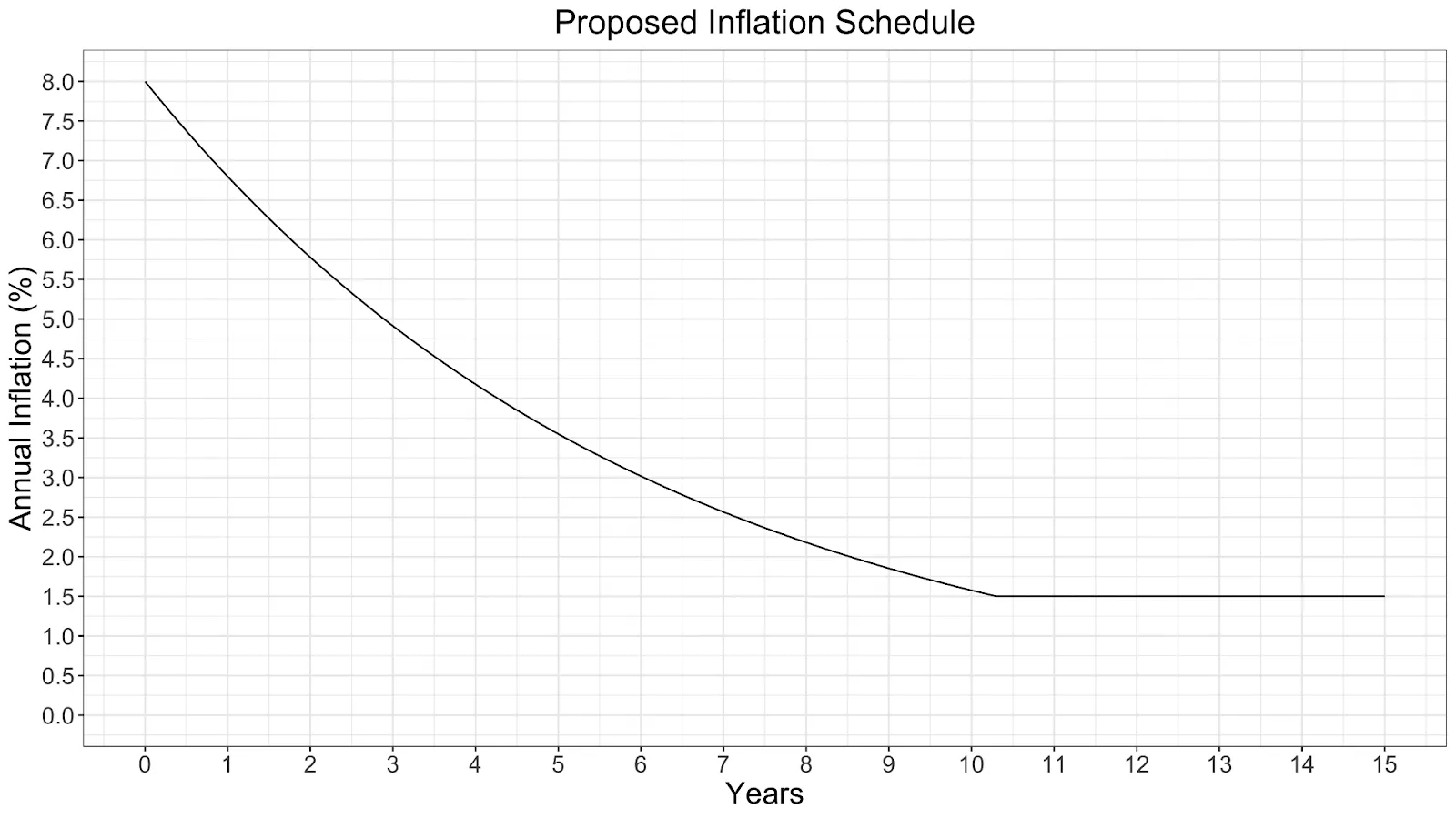
This means early stakers received higher percentage rewards, which gradually decrease as the network matures. The inflation tokens are distributed primarily to validators and delegators as staking rewards.
Why inflation? Inflation incentivizes participation in network security. Without rewards, there would be less motivation to stake SOL and run validators. The decreasing schedule balances early growth incentives with long-term token value.
Token Burning
To counterbalance inflation, Solana implements a burning mechanism:
- A portion of every transaction fee is permanently destroyed
- Burned tokens are removed from circulation forever
- This creates deflationary pressure against the inflationary supply
The burn rate depends on network activity. During periods of high usage, more fees are collected and burned, potentially offsetting a significant portion of inflation. There's ongoing debate in the community about whether the current burn rate is sufficient to make SOL net-deflationary under normal conditions.
Supply Dynamics Summary
Inflationary forces:
- New SOL minted each epoch for staking rewards
- Currently ~ 3.84% (decreasing by ~15% annually toward a long-term target of 1.5%)
Deflationary forces:
- Transaction fee burning
- Varies with network activity
The net result depends on the balance between these forces. High network usage increases burning, while staking participation determines how inflation is distributed.
How to Stake SOL
Staking is the most straightforward way to earn yield on your SOL while contributing to network security.
Option 1: Native Staking
TL;DR: Delegate SOL directly to a validator for ~5–6% APY. Simple and low-risk, but your SOL is locked for 2-4 days when unstaking.
Native staking means delegating your SOL directly to a validator through your wallet.
How to stake natively:
- Open a Solana wallet (Phantom, Solflare, etc.)
- Navigate to the staking section
- Browse available validators
- Consider commission rates (typically 0-10%) and performance
- Delegate your SOL
- Rewards accrue automatically each epoch (~2 days)
Current APY: ~5-6% depending on validator performance and commission
Minimum: 0.01 SOL
Considerations:
- Lockup: Unstaking takes 2-4 days (one epoch plus cooldown)
- Validator risk: Poor validator performance reduces your rewards
- No liquidity: Staked SOL cannot be used elsewhere until unstaked
Option 2: Liquid Staking
TL;DR: Stake through protocols like Sanctum to receive liquid tokens (LSTs) that earn rewards while remaining tradeable and usable in DeFi. Best option for most users.
Liquid staking protocols stake your SOL and issue you a liquid staking token (LST) in return. This LST represents your staked position and appreciates in value as staking rewards accrue.
Benefits of liquid staking:
- Maintain liquidity: Trade or use your LST anytime
- DeFi composability: Use LSTs as collateral, provide liquidity, or enter yield strategies
- Instant unstaking: Swap LSTs for SOL on DEXs without waiting
- Potentially higher yields: Some LSTs earn additional revenue beyond base staking
Popular liquid staking options:
Sanctum Infinity (INF): 6.28% average APY since March 2026
- Holds a basket of LSTs for diversification
- Earns staking yields plus trading fees from Sanctum's unified liquidity layer
- Often highest due to diversified LST basket + trading fees
- The highest performing LST of 2025, outperforming the LST median (smoothed over 5 epochs) by approximately 20% on a relative basis.
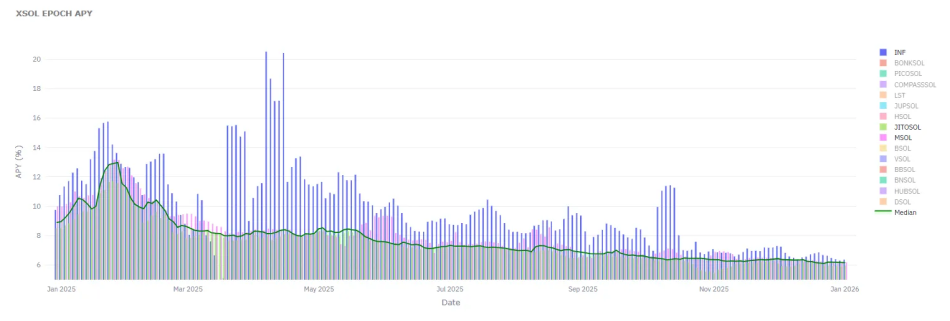
JitoSOL: 5.69% average APY since March 2026
- Largest single LST with $2B+ TVL
- Integrates MEV (maximal extractable value) rewards
- Broad DeFi integrations
mSOL (Marinade): 6.09% average APY since March 2026
- One of the original Solana LSTs
- Delegates across 100+ validators
- Extensive DeFi support
Staking Comparison
| Method | APY | Liquidity | Complexity | Best For |
|---|---|---|---|---|
| Native Staking | ~6–7.5% | 2-4 day unlock | Simple | Long-term holders, decentralization supporters |
| Liquid Staking (INF) | 7–8.5%+ | Instant | Simple | Most users seeking optimized yield |
| Liquid Staking (JitoSOL, mSOL) | 6–8% | Instant | Simple | Users wanting single-protocol exposure |
How to Buy SOL
Acquiring SOL is straightforward through several methods:
Centralized Exchanges
The most common method for first-time buyers:
- Create an account on a major exchange (Coinbase, Binance, Kraken, etc.)
- Complete identity verification (KYC requirements)
- Deposit funds via bank transfer, credit card, or other payment methods
- Buy SOL by placing a market or limit order
- Withdraw to your wallet for self-custody and staking
Note: Leaving SOL on an exchange means you don't control your keys. For security and to earn staking rewards, withdraw to a personal wallet.
Decentralized Exchanges
If you already hold crypto on Solana:
- Connect your wallet to a DEX like Jupiter, Raydium, or Orca
- Swap your existing tokens for SOL
- SOL arrives directly in your wallet
On-Ramps
Many wallets include built-in on-ramps:
- Phantom and Solflare offer direct purchase options
- Services like MoonPay enable card purchases
- Fees are typically higher than exchanges but more convenient
How to Store SOL
Proper storage is essential for security. You have several options:
Software Wallets (Hot Wallets)
Free applications that run on your device:
Phantom: The most popular Solana wallet
- Browser extension and mobile app
- Built-in staking, swaps, and NFT support
- User-friendly interface
Solflare: Feature-rich alternative
- Browser, mobile, and hardware wallet support
- Advanced staking options
- Ledger integration
Hardware Wallets (Cold Storage)
Physical devices that store your keys offline:
Ledger: Industry-leading hardware wallet
- Supports SOL and SPL tokens
- Works with Phantom and Solflare
- Best security for large holdings
Security Best Practices
- Write down your seed phrase and store it securely offline
- Never share your seed phrase with anyone
- Use hardware wallets for significant holdings
- Verify addresses before sending transactions
- Be cautious of phishing sites and fake wallet apps
- Use a dedicated device that is exclusive to crypto activities.
SOL vs. Other Cryptocurrencies
How does SOL compare to other major crypto assets?
SOL vs. ETH
| Aspect | SOL | ETH |
|---|---|---|
| Transaction speed | ~0.4 seconds | ~12 seconds |
| Average fee | $0.00025 | $0.30+ |
| Native staking APY | ~5–6% | ~2-3.5% |
| Supply model | Inflationary (decreasing to 1.5%) | Net deflationary post-merge |
| Market maturity | Younger, higher growth potential | Established, larger ecosystem |
SOL vs. BTC
| Aspect | SOL | BTC |
|---|---|---|
| Primary use | Application platform utility | Store of value |
| Supply | Inflationary | Fixed (21 million max) |
| Consensus | Proof of Stake | Proof of Work |
| Native staking APY | ~5–6% | N/A (no native staking) |
| Smart contracts | Yes | Limited |
Risks and Challenges
No investment guide is complete without understanding the risks. SOL and Solana face several challenges:
Centralization Concerns
Solana’s validator network is significantly smaller than Ethereum’s and has become more concentrated over time. The number of active validators has declined to roughly 750–1,000 (down from a peak of over 2,500 in 2023). High hardware and operational requirements — including annual voting transaction fees of approximately 350–400 SOL — make running a validator less accessible than on many competing networks. Critics argue this concentrates power among well-funded operators and reduces overall decentralization.
Security Risks
Some Solana DeFi projects have been targeted by hacks and exploits. While these are typically protocol-specific vulnerabilities rather than issues with the Solana L1 itself, they highlight the importance of due diligence when using any DeFi application. Always research protocols thoroughly before depositing funds.
Competition
Solana faces intense competition from Ethereum and Hyperliquid. The blockchain landscape evolves rapidly, and today’s advantages may not persist.
FAQs
What is SOL?
SOL is Solana's native cryptocurrency. It's used to pay transaction fees on the network and can be staked to help secure the blockchain while earning rewards. SOL uses the SPL token standard and is essential for any interaction with Solana applications.
What is SOL used for?
SOL has five main uses: paying transaction fees, staking to secure the network and earn rewards, validator rewards for processing transactions, governance participation, and trading/investment. Every action on Solana requires a small amount of SOL.
How many SOL tokens are there?
Solana launched with an initial supply of 500 million SOL. The actual supply fluctuates due to inflation (new tokens minted for staking rewards) and burning (transaction fees removed from circulation). The inflation rate started at 8% and decreases annually toward a 1.5% long-term target.
Is SOL inflationary or deflationary?
SOL is currently net inflationary, with new tokens minted each epoch for staking rewards. However, a burning mechanism destroys a portion of transaction fees. Whether SOL becomes net deflationary depends on network activity, higher usage means more fees burned, potentially offsetting inflation.
How much can I earn staking SOL?
Native staking yields approximately 5–6% APY depending on validator performance and commission. Liquid staking through protocols like Sanctum Infinity can yield 6-8%+ due to additional fee revenue. Yields fluctuate based on network conditions and total stake participation.
What's the difference between native and liquid staking?
Native staking locks your SOL with a validator for 2-4 days when unstaking. Liquid staking gives you a tradeable token (LST) representing your staked position, maintaining liquidity while still earning rewards. LSTs can be used in DeFi for additional yield opportunities.
How do I stake SOL?
For native staking: open a wallet like Phantom, navigate to staking, choose a validator, and delegate. For liquid staking: visit Sanctum, connect your wallet, deposit SOL, and receive liquid staking tokens. Both methods earn rewards automatically.
Where can I buy SOL?
SOL is available on major centralized exchanges (Coinbase, Binance, Kraken), decentralized exchanges on Solana (Jupiter, Raydium), and through wallet on-ramps (Phantom, Solflare). For self-custody and staking, withdraw to your own wallet after purchase.
How do I store SOL safely?
Use a reputable wallet like Phantom or Solflare for convenience, or a hardware wallet like Ledger for maximum security. Always write down your seed phrase and store it offline. Never share your seed phrase with anyone, and be cautious of phishing attempts.
What determines SOL's price?
SOL's price is influenced by network adoption, developer activity, staking participation, broader crypto market conditions, and supply dynamics (inflation vs. burning). Like all cryptocurrencies, it's highly volatile and speculative.
What are the main risks of holding SOL?
Key risks include: centralization concerns (fewer validators than Ethereum), smart contract vulnerabilities in DeFi protocols, competition from other blockchains, and general cryptocurrency market volatility. Always do your own research and only invest what you can afford to lose.